
The Path Through the Woods
Questions from the Epilepsy Clinic v1.33

----
The Question
A recent patient asked a question I hear in some version almost every week: “If I have been seizure free for months or years do I still need to be taking medication? Is it possible that I’m cured?”
This question is the topic of this week’s newsletter. It is the question of whether the disease itself can heal.
----
The Gap
I often come up with and try out different analogies and metaphors to help explain how I understand some of these abstract and complicated topics. This week was another new one, I asked my patient to think of seizures like a path through the woods. If you walk that path every day, the plants stay trampled. The trail gets clearer, easier to find, easier to walk. But if you stop walking it, the grass grows back, saplings fill in. Eventually, the path disappears entirely. You could walk right past where it used to be and never know it was there.
This tracks with a concept called kindling. Repeated seizures can change the brain in a significant way and make it easier and more likely for seizures to continue. Cells get damaged, connections (wires) can reorganize, neurons that are designed to keep control of runaway electrical networks (inhibitory neurons) can be lost [1][2][3]. That is the well-worn path.
But the path can also fill in once seizures are controlled. With the right medication or combination of meds, about 2 out of 3 patients can eventually get to complete seizure control [1][4]. Of those who are seizure free, half to two thirds can come off of their meds without any return of their seizures. Their path has genuinely filled in.
The real question is: for which patients has the path truly grown over, or is the medication just keeping you from walking it?
----
The Only Real Test
The only way to know whether the underlying epilepsy has resolved is to carefully taper off of the medication and see what happens. “So we just try coming off and wait to see if a seizure returns?” Essentially, yes.
----
Who Is Building a Better Tool?
Right now, the decision to try stopping medication is mostly a judgment call. We weigh how long someone has been seizure free, what caused their epilepsy, what their EEG looks like and what impact a breakthrough seizure would have on their life. Useful, but it is not precise. Validated prediction tools do exist but they only correctly predict the result about 2/3rds of the time [5]. Again, useful, but not precise. A 2024 review put it plainly: models like nomograms are easy to use but risk being overly simplified. Machine learning models can handle more complexity but have not yet been proven reliable across different patient populations [6]. We are stuck between a tool that is usable but limited and tools that are powerful but unproven.
An updated EEG recording prior to any withdrawal decision does add information, but in a somewhat blunt way. A neurologist looks at the recording and checks for epileptiform discharges (electrical spikes between seizures, like sparks from a campfire that has not fully gone out). Sparks mean higher risk. No sparks means lower risk [5]. It is a validated biomarker. But it is also a fairly binary read on (typically) a 30-minute snapshot of a brain that has been cycling in and out of seizure states for years or sometimes decades.
----
What Could Replace It?
Four areas to keep an eye on.
Quantitative EEG. We already obtain the EEG. But are we leaving information on the table by only looking at it with human eyes. Software tools have found patterns that neurologists cannot see which might carry prognostic value: how “complex” are the brain’s electrical signals? which frequency bands are most active? how do different brain regions talk to each other? All may be factors in whether a patient will have a seizure relapse or not if meds are withdrawn [7].
Seizure cycling and long term monitoring. Long term recordings through implanted brain devices (like the RNS system) has shown that up to 90% of patients appear to have rhythms in their seizure activity, they have seizure risk cycles spanning days, weeks, or longer [8]. These types of tools were not designed for withdrawal decisions. But think about what they offer: continuous, months-long brain recording data. Right now we decide whether to stop medication with the help of a 30-minute EEG and a patient’s memory of their last seizure. Implanted recordings could eventually tell us whether the underlying electrical instability is truly gone or just quiet at that moment we were looking.
Blood biomarkers. This appears furthest from clinical use, but conceptually still very compelling. If seizures cause brain inflammation and neuron injury, maybe we can detect the residue in a blood draw. A recent study identified a panel of ten proteins that showed potential promise for distinguishing seizure-free patients from those still having seizures [9]. One protein called Neurofilament light chain (a protein released when neurons are damaged) correctly identified epilepsy 95% of the time when distinguishing it from seizure-like events that are not caused by abnormal electrical activity in the brain [10]. GFAP (a marker of astrocyte activation, the brain’s support cells responding to injury) also shows potential promise [11]. None are ready for clinical use. But they point toward something we do not have: direct insight into whether the epilepsy process is still active. A soil sample from the trail, rather than a guess to decide how long since someone last walked it.
----
The Path to the Patient
Quantitative EEG tools would likely enter the market as software-as-a-medical-device (the FDA pathway for algorithms that interpret existing clinical data). Several EEG analytics companies already exist in adjacent spaces for seizure detection. The regulatory path exists. The reimbursement path exists too but will likely need to be expanded: CPT codes for computer-assisted EEG interpretation cover versions of this kind of analysis. What does not exist yet is a validated, FDA-cleared algorithm specifically designed to predict medication withdrawal outcomes. That is probably three to five years out if someone builds it.
Data from an implanted device has a well defined reimbursement pathway which removes this major hurdle but validation and prospective studies will still need to happen before it has clinical utility in supporting medication withdrawal decisions.
Blood panels face longer roads related to both validation and reimbursement [12]. A blood draw that meaningfully informs a withdrawal decision is probably five to ten years away.
Regarding the use of EEGs to develop and validate some of these tools, the infrastructure problem may actually be bigger than the science problem. Reviews have found that differences in performance between prediction algorithms can often be attributed to the quality of the underlying EEG dataset and not from the algorithms themselves [14].
----
My Take
The path analogy gives patients a framework for understanding their own disease that I believe accurately portrays both the possibility of remission and the reality of persistence.
My position is that the most promising near-term development to keep an eye on is the potential integration of quantitative EEG analysis into routine pre-withdrawal assessment. We already obtain the EEG. Tools that extract additional features from it already exist in proof-of-concept form [7]. The gap is really in implementation, not invention. If that integration happens in the next three to five years, the standard of care for medication withdrawal decisions could look meaningfully different (better.)
The blood biomarkers are further out, but the possibility of measuring the state of the path directly, rather than inferring it from how long the patient has avoided walking it would carry a lot of weight.
Continuous wearable data, spanning months to years, may eventually provide the longitudinal context that a single EEG snapshot cannot, but time will tell and a lot of work still needs to happen on that front [8].
For the patients whose questions started this issue: yes, seizures can go away. The path can fill in. But it fills in faster and more completely when we stop every seizure, not just most of them and when we stop them early. And the only way to know if it has truly healed is to look. The tools for looking are imperfect today but improving. That said, the decision on whether or not to trial coming off meds when seizure free for extended periods of time should not wait for perfection.
----
Lagniappe
I’m stealing a page out of the Tulane and New Orleans playbook by adding a “Lagniappe” section to the end of these letters. For those that don’t know “Lagniappe” means “a little something extra” in New Orleans culture.
Feels appropriate to make the lagniappe for this letter all about paths.
First, some additional “path” related readings I’ve enjoyed recently:
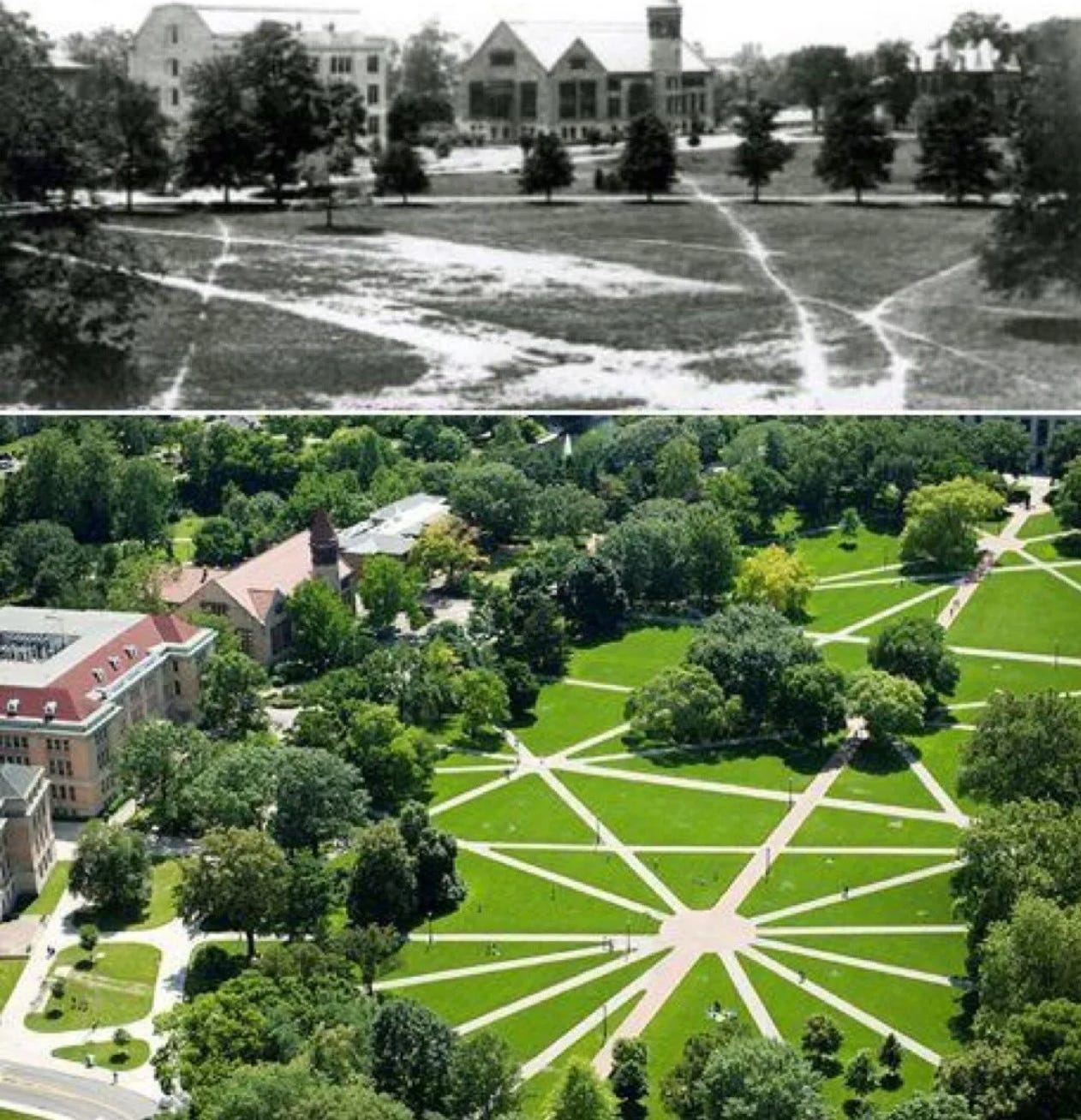
Desire paths: How UI designers can learn from the ways we walk around
Next,
A nice 2014 New Yorker article discussing walking, writing, attention, creativity, and environment.
And can’t really talk about woods and paths without including “The Road Not Taken” by Robert Frost to send us into the weekend.
Two roads diverged in a yellow wood,
And sorry I could not travel both
And be one traveler, long I stood
And looked down one as far as I could
To where it bent in the undergrowth;
Then took the other, as just as fair,
And having perhaps the better claim,
Because it was grassy and wanted wear;
Though as for that the passing there
Had worn them really about the same,
And both that morning equally lay
In leaves no step had trodden black.
Oh, I kept the first for another day!
Yet knowing how way leads on to way,
I doubted if I should ever come back.
I shall be telling this with a sigh
Somewhere ages and ages hence:
Two roads diverged in a wood, and I—
I took the one less traveled by,
And that has made all the difference.
----
References
[1] Jiruska et al., Epilepsia, 2023
[2] Sutula, Epilepsy Research, 2004
[3] Sayin et al., Journal of Neuroscience, 2003
[4] Thijs et al., Lancet, 2019
[5] Lamberink et al., Lancet Neurology, 2017
[6] Sheikh and Jehi, Current Opinion in Neurology, 2024
[7] Ouyang et al., International Journal of Neural Systems, 2020
[8] Stirling et al., Epilepsia, 2021
[9] Ashtiani et al., PLoS One, 2025
[10] Dobson et al., Epilepsia, 2024
[11] Thaele et al., Seizure, 2026
[12] Simonato et al., Nature Reviews Neurology, 2021
[13] Lin et al., Epilepsia, 2020
[14] Luo et al., eClinicalMedicine, 2025